Vietnam Cold Storage Market 2026 – 2030: A Strategic Anchor and Map of Regional Opportunities
Vietnam’s logistics industry is undergoing a profound transformation, with the storage infrastructure segment, particularly cold storage, emerging as one of the most attractive and strategic investment channels. The boom in e-commerce, shifting FDI inflows, and the rising demand for international-standard agricultural and seafood exports are pushing the demand for modern warehousing to unprecedented heights.
Join C+ Consult in analyzing the comprehensive landscape of the warehousing market in general, with a special focus on cold storage and the breakthrough opportunities from now until 2030.
- Overview of the Vietnam Cold Storage Market in Recent Years
The General Warehousing Market: Rocketing Growth
In recent years, the Modern Warehousing segment in Vietnam has witnessed an aggressive wave of expansion. According to data from FiinGroup, the total Net Leasable Area (NLA) grew at an impressive CAGR of up to 23% (during the 2020-2023 period) and continues to maintain strong growth momentum. The overall warehousing market size is estimated to have reached the USD 5.6 billion mark. The active participation of foreign giants such as Mapletree, SLP, and BW Industrial, alongside domestic players like Transimex and Gemadept, has redefined logistics infrastructure standards toward larger-scale and smarter operations.
The Vietnam Cold Storage Market: Starving for High-Standard Supply
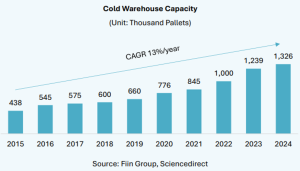
As a specialized branch of warehousing, cold storage has developed along a separate track characterized by strict technical barriers and high initial capital expenditure. Data from B&Company and FiinGroup indicate that Vietnam’s cold storage capacity has maintained an impressive compound annual growth rate (CAGR) of approximately 13% over the past decade.
- Capacity Scale: By 2024, there were approximately 117 large-scale commercial cold storage facilities nationwide, with a total capacity of around 1.32 million pallets.
- Occupancy Rate: Despite continuous capacity expansion, the market’s average utilization rate has consistently remained at an ideally high level, around 80%. This demonstrates a persistent and high-volume flow of temperature-sensitive goods requiring specialized storage.
- Fragmentation: The market currently features around 90 professional operators. However, it remains highly fragmented, with more than half being small-scale players operating under 10,000 pallets. The top 10 market leaders (such as Lineage Logistics, Transimex, Hung Vuong, AJ Total, Meito, Harano TNS, etc.) account for approximately 42% of the total national capacity.
- Growth Potential and Room for Expansion Toward 2030
Despite its rapid growth, Vietnam’s cold storage infrastructure is still deemed “undersupplied” relative to actual demand. Currently, Vietnam’s cold storage capacity index stands at a mere 132 pallets per 10,000 people. This figure is significantly lower than Thailand’s (204), and lags far behind developed markets like China (913) and Japan (1,592).
International research organizations forecast that from now until 2030, the general warehousing market will maintain a steady CAGR of 10.5% – 11%. Meanwhile, the cold storage segment is expected to grow even faster, with a projected CAGR of around 14%. Total market capacity is highly anticipated to cross the 1.7 million pallet threshold.
Core Drivers Powering the Market Toward 2030:
- Leverage from Free Trade Agreements (FTAs): Vietnam has emerged as a premier agricultural and seafood export hub (shrimp, pangasius, fruits…) to highly demanding markets, facilitated by the EVFTA, CPTPP, and RCEP. This requires the entire supply chain to meet global standards, from pre-cooling facilities at farms to cold storage warehouses at major seaports.
- The Pharmaceutical & Biological Boom: The pharmaceutical market is projected to grow steadily at 5% per annum. The critical need to store vaccines and temperature-sensitive biologicals (requiring strict temperature controls between 2°C and 8°C or lower) is driving massive demand for advanced GSP/GDP-compliant cold storage facilities, a segment that commands premium rental rates.
- Government “Green Logistics” Mandates: Prime Minister’s Decision No. 496/QĐ-TTg pushes the refrigeration industry to phase out ozone-depleting substances and greenhouse gases. This directive is catalyzing a new wave of investment in automated systems, low-GWP refrigerants, eco-friendly insulation, and rooftop solar power.
- Cold Storage Geographical Map: Regional Features and Advantages
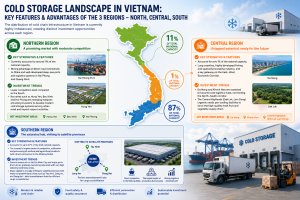
The distribution of cold chain infrastructure across Vietnam currently shows a stark imbalance, offering distinct investment dynamics for each region:
The South: A Saturated Hub Shifting Toward Satellite Provinces
- Features & Advantages: Holding 87% of the total national capacity, the South serves as the primary agricultural, aquaculture, and food processing hub of the country, directly connected to the Mekong Delta.
- Investment Trends: Prime locations in Ho Chi Minh City or near major ports (like Cat Lai) are reaching saturation and command high industrial land lease rates. Consequently, massive capital inflows are shifting toward satellite provinces with optimized land costs, such as Tay Ninh, Long An, and Dong Nai, which serve as ideal consolidation and transit hubs.
The North: Promising Land with Moderate Competition
- Features & Advantages: Currently representing 11% of national capacity. The North benefits from direct land border trade routes with China and synchronized deep-sea port logistics infrastructure in Hai Phong and Quang Ninh.
- Investment Trends: Competitive intensity in the North is relatively lower than in the South. Areas like Hung Yen, Bac Ninh, and Hai Phong have become hot spots for developers building modern cold warehouses to serve urban retail and import-export demands.
The Central Region: Untapped Space Pioneering Future Trends
- Features & Advantages: Accounting for just 1% of the national capacity. However, this region features a long coastline with thriving fisheries and serves as the strategic East-West Economic Corridor.
- Investment Trends: Key urban hubs like Da Nang and Khanh Hoa are projected to transform into cold chain transit hubs along the North-South axis. Concurrently, the Central Highlands (Dak Lak, Lam Dong) are in high need of pre-cooling and storage infrastructure to support their high-value fruit and fresh vegetable supply chains.
| “In Vietnam today, the distribution of cold storage is highly uneven. While the demand is enormous, facilities are heavily concentrated in the South. Within the Southern region, there is a strong concentration toward the West, specifically in the Tay Ninh area (formerly part of the old Long An border). This area has the distinct advantage of being close to expressways and seaports, making it highly convenient for seafood and agricultural enterprises from the Mekong Delta, Southeast region, or Central Highlands to transport their goods here. As a result, cold storage has clustered here in very large volumes”
Mr. Tung, Chairman of the Board of a cold storage company in Tay Ninh |
Notable Market Movements (2024–2025)
Vietnam’s cold storage industry has seen major developments, highlighting the surging demand from food companies, retail giants, and third-party logistics (3PL) providers:
- March 19, 2025: South Korea’s LOTTE Global Logistics broke ground on a cold storage center valued at approximately USD 1.4 billion in Nhon Trạch Industrial Park, Dong Nai, spanning 5.5 hectares and scheduled for completion by May 2026.
- July 5, 2024: Japan’s Daiwa House Logistics Trust completed the acquisition of the built-to-suit “Tan Duc 2 Project” in Long An for approximately USD 20 million, backed by a 20-year long-term lease with a Japanese 3PL tenant.
- June 27, 2024: Nichirei TBA Logistics Vietnam inaugurated its Long Hau cold warehouse (Long An), offering approximately 20,000 pallet positions across 10 temperature-controlled rooms ranging from −25°C to 22°C.
Conclusion and Business Matchmaking Opportunities at ViLogs 2026
The Vietnamese cold storage market in the 2026 – 2030 period is no longer just a race for physical expansion; it has elevated into a competition over green technology, smart temperature management, and regional geographical optimization. For businesses, finding the right infrastructure providers and cold-chain technology partners is the ultimate key to mastering a resilient supply chain.
Understanding this vital need, the Vietnam International Logistics Exhibition (ViLogs 2026) will be the most comprehensive and prestigious gathering of the year for the logistics, cold chain, and warehousing communities. The event will bring together hundreds of global providers showcasing automated cold storage technology, smart temperature monitoring systems, and advanced refrigerated transport solutions.
As a Media Partner of ViLogs 2026, C+ Consult is proud to serve as an information bridge, helping businesses stay ahead of market trends and expand their trading networks effectively.
👉 Contact C+ Consult for exhibition details or register to visit the exhibition directly at: https://vilog.vn/dang-ky-tham-quan/

References & Sources:
– Vietnam Cold Chain Supply Report (FiinGroup)
– Cold Storage Market Research and Strategic Investment Opportunities (B&Company)
– Vietnam Business Whitebook 2025 (B&Company)
– Vietnam Cold Storage Market: Strategic Investment Opportunities (B&Company)
– Vietnam Warehouse Market Forecast Report to 2034 (Expert – Market Research & Research and Markets)
– General Statistics Office data & strategic logistics infrastructure decisions of the Prime Minister.
– Cold storage surplus and shortage: the logistics challenge for agricultural exports.