Vietnam and the EU Upgrade Relations to a Comprehensive Strategic Partnership
On January 29, 2026, Vietnam and the European Union (EU) officially upgraded their relationship to a Comprehensive Strategic Partnership, the highest level in bilateral relations. This historic milestone marks a new chapter in more than three decades of cooperation and underscores Vietnam’s growing strategic role in the global economic and geopolitical landscape.
A Historic Milestone and Strategic Context in Vietnam–EU Relations
The elevation of Vietnam–EU relations to a Comprehensive Strategic Partnership represents a major step forward, reflecting a high level of political trust and the depth of cooperation between the two sides. Over more than 35 years since establishing diplomatic relations, Vietnam and the EU have built a comprehensive partnership spanning politics, trade, development, and people-to-people exchanges.
Vietnam has become the first ASEAN country to establish a relationship with the EU at this highest level, highlighting its increasing importance in the EU’s Indo-Pacific strategy. For the EU, Vietnam is viewed as a key partner in Southeast Asia, serving as a strategic bridge connecting Europe with one of the world’s fastest-growing regions. The upgrade also reflects shared interests in stability, sustainable development, and a rules-based international order.

President Lương Cường and European Council President Antonio Costa at the Presidential Palace on January 29
New Pillars of Cooperation: Economy, Technology, Supply Chains, and Green Transition
One of the core pillars of the Comprehensive Strategic Partnership is the strengthening of economic, trade, and investment cooperation. The EU–Vietnam Free Trade Agreement (EVFTA) has laid a solid foundation for expanding bilateral trade, making the EU one of Vietnam’s major trading and investment partners.
Within the new framework, both sides committed to deepening cooperation in strategic sectors such as semiconductor supply chains, high-tech industries, critical minerals, artificial intelligence, and digital transformation. Vietnam is increasingly recognized as an emerging manufacturing hub in global supply chains, while the EU seeks to diversify sourcing and reduce dependence on traditional markets.
Green transition and sustainable development also constitute key pillars of the partnership. The two sides are promoting cooperation under the Just Energy Transition Partnership (JETP), green finance, low-emission transportation, and sustainable agriculture. These initiatives align with Vietnam’s commitment to achieving net-zero emissions by 2050 and strengthen the country’s competitiveness in the global green economy.
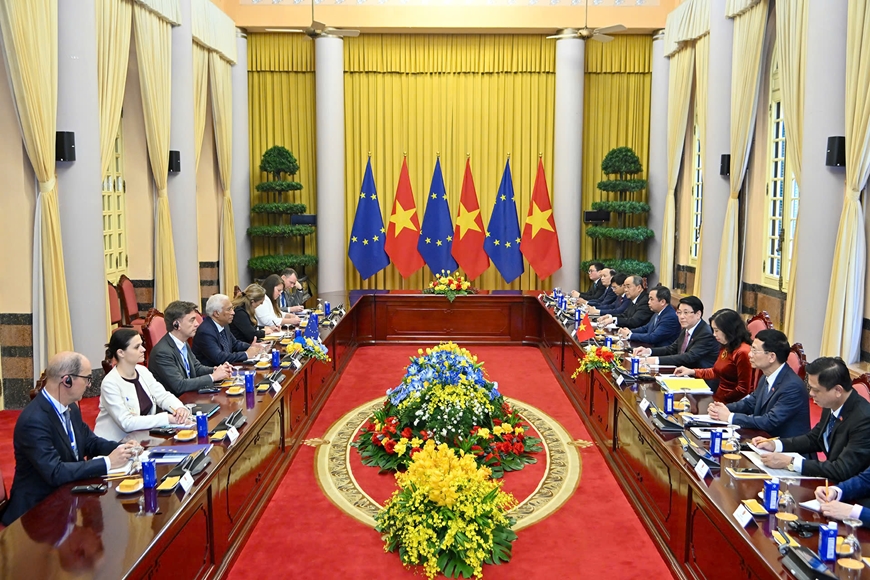
The scene of discussions
Cooperation on Security, Foreign Policy, and Multilateralism amid Geopolitical Shifts
Beyond economic cooperation, the Comprehensive Strategic Partnership expands collaboration in political, security, and defense areas. The two sides agreed to enhance dialogue on maritime security, cybersecurity, crisis management, and peacekeeping operations.
Vietnam and the EU reaffirmed their commitment to multilateralism, the rule of law, and the central role of the United Nations, particularly the United Nations Convention on the Law of the Sea (UNCLOS) 1982. In a context of intensifying great-power competition and geopolitical uncertainties, this shared commitment contributes to strengthening a rules-based international order and regional stability.
The partnership also reflects a convergence of strategic interests in the Indo-Pacific region, where both Vietnam and the EU seek to promote peace, connectivity, and inclusive development while maintaining strategic autonomy.
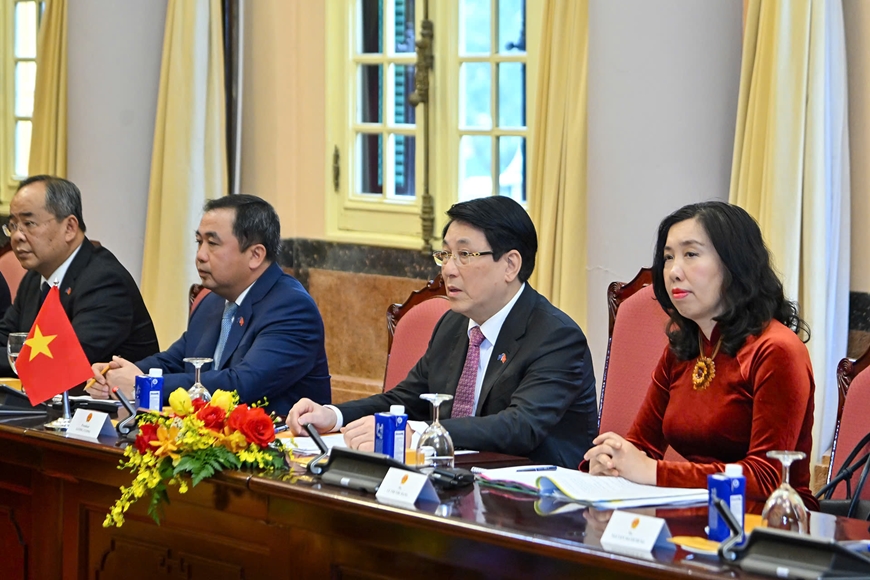
President Lương Cường and the high-ranking delegation of Vietnam attended the talks
Strategic Significance and Long-Term Outlook of the Comprehensive Strategic Partnership
Upgrading relations with the EU carries profound strategic significance for Vietnam’s foreign policy of diversification and multilateralization. The partnership enhances Vietnam’s international standing, attracts high-quality European investment, and accelerates the transformation of its growth model toward innovation, sustainability, and integration into global value chains.
For the EU, Vietnam is a pivotal partner in Southeast Asia and a gateway for expanding Europe’s economic and political presence in the Indo-Pacific region. The Comprehensive Strategic Partnership enables the EU to deepen cooperation in technology, energy, and supply chains amid increasing global competition and strategic fragmentation.
Nevertheless, the implementation of the partnership will face challenges, including differences in technical standards, environmental and labor regulations, and trade policies. Despite these obstacles, strong political commitment from both sides and a growing foundation of cooperation are expected to drive the relationship into a high-quality, sustainable, and strategic phase in the long term.
Conclusion
The upgrade of Vietnam–EU relations to a Comprehensive Strategic Partnership marks a historic milestone in bilateral ties and in Vietnam’s broader foreign policy strategy. This new framework not only expands cooperation in economy, technology, and sustainable development but also elevates Vietnam’s role in regional and global structures. As the global order continues to evolve, the Vietnam–EU partnership is set to become a key pillar supporting Vietnam’s strategic balancing and deeper integration into the global economic and political system.